


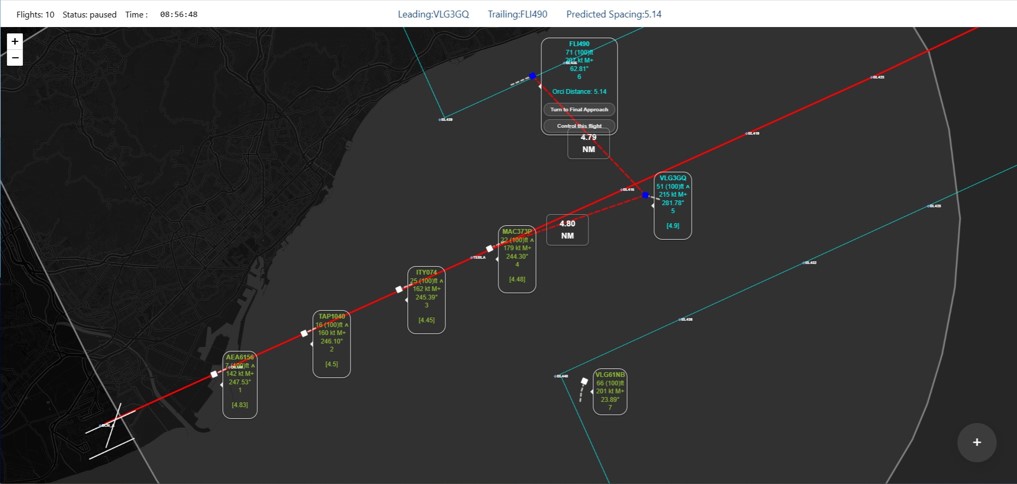
As air traffic demand continues to grow, arrival management operations are becoming increasingly complex. Air traffic controllers must ensure safe separation while maintaining efficient and predictable arrival flows, often under conditions of uncertainty and high workload.
In this context, the future of air traffic management is expected to rely more heavily on data-driven and predictive tools to support operational decision-making.
Traditional arrival management systems provide support for sequencing aircraft and estimating arrival times. However, many operational challenges remain, particularly when it comes to anticipating how the distance between aircraft will evolve during the arrival phase. Variability in aircraft performance, weather conditions, and operational constraints can make spacing difficult to predict accurately.
This is where projects like ORCI contribute to the evolution of ATM.
By focusing on aircraft spacing prediction, ORCI explores how machine learning models can provide early and more accurate estimations of future distances between aircraft. This type of information could complement existing tools by giving controllers additional insight into how the situation will develop.
Looking ahead, predictive capabilities could support:
- More stable arrival sequences, reducing the need for tactical interventions
- Improved workload management for controllers
- Better use of advanced procedures, such as RNAV-based operations
- Enhanced robustness in the presence of uncertainty
In particular, environments such as Barcelona, where trombone manoeuvres are used, or Lisbon, with Point Merge operations, highlight the importance of anticipating how spacing evolves over time. In these contexts, early predictions could help optimise sequencing decisions and improve overall efficiency.
While these concepts are still under development and evaluation, the results obtained within ORCI suggest that predictive tools have the potential to play a key role in future ATM systems.